Why agent-readiness matters now
AI agents already land on websites to answer questions people ask in Claude, ChatGPT, Copilot, Google AI Mode, Gemini, Grok, Perplexity, and other LLMs. That can be a customer-support bot, a coding assistant, or a research agent working for your customer. They do that work more efficiently when your site is machine-readable.
The open question is whether your website makes sense to those agents when they arrive. Companies like Ramp, SerpApi, and others have already made their websites agent-ready.
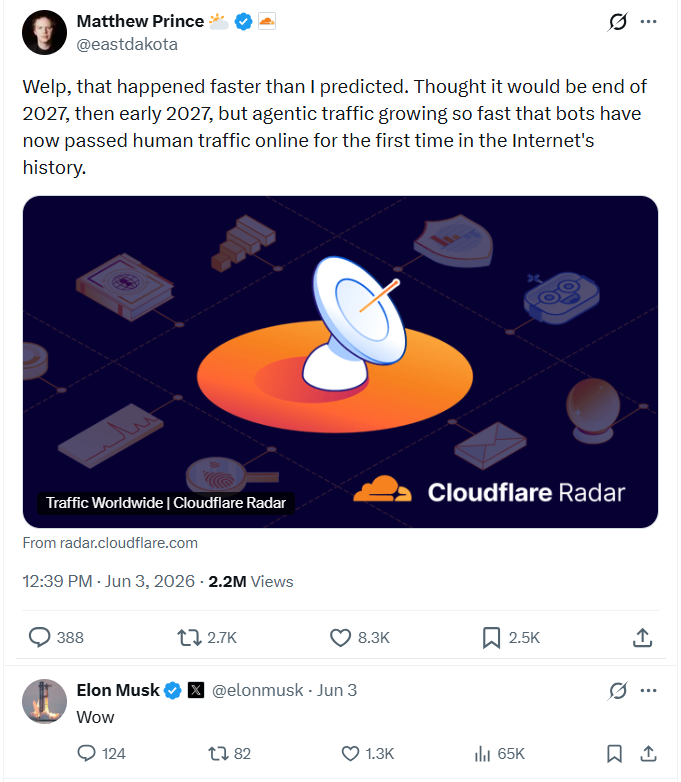
In June 2026, website traffic from AI agents finally surpassed humans…
Source: Visionary Marketing 2026
Source: SearchSignal 2026
Source: Gartner 2026 predictions
Source: Thunderbit 2026
The standards behind our agent-readiness package
The agent-readiness files we install are defined by published standards, working-group proposals and specifications, and Google guidelines. People, organizations, and companies you can look up write those rules.
The founding proposal
llms.txt was proposed by Jeremy Howard of Answer.AI in September 2024. His premise: "Site authors know best, and can provide a list of content that an LLM should use."
Google Chrome recognition
llms.txt is no longer a community-only proposal. As of May 2026, Google Chrome's Lighthouse includes an experimental "Agentic Browsing" audit for the file. That is developer tooling recognizing the convention for agents (absence is currently not applicable, not a failing check). It is separate from a Google Search ranking signal.
Source: Google Chrome for Developers, Lighthouse llms.txt audit
Academic specification
agent-permissions.json is a formal manifest published by the Lightweight Agent Standards Working Group (researchers from Oxford, Stanford, and Microsoft) in August 2025. It is one of the files we install.
Source: Marro et al., Permission Manifests for Web Agents (arXiv:2601.02371)
We treat llms.txt as foundational for agent-readiness. We include it with the rest of your agent-readiness package (13 files). To learn more, explore the agent-readiness package files, explained.
What Ramp learned when they marketed to AI agents
In early 2026, Ramp came to a realization: every company’s website was built for humans, and marketing to agents is becoming just as important. Across roughly 50 marketing pages, Markdown was the only tested format that reliably surfaced in LLM responses, while model behavior diverged sharply over a 32-day window.
That is empirical B2B evidence for agent-readable Markdown files. The caveats still apply: no citation, ranking, or conversion guarantees, and progress tracked over time.
We solve agentic browsing, and leave SEO fundamentals to your SEO work
Google's guidance on AI features in Search says special AI files, AI-only markup, or llms.txt files are not required to appear in AI Overviews or AI Mode or to achieve a higher ranking in results. The same applies to regular Google Search.
AI Overviews, AI Mode, and regular Google Search rely on established SEO fundamentals: crawlability, indexability, useful people-first content, clear technical structure, page experience, and standard Search eligibility. We do not improve your SEO fundamentals or your website’s ranking in Google AI Overviews, AI Mode, or Google Search.
AgentReadyWebsite focuses on agent-readiness. We help AI agents that land on your website (research agents and assistants working inside Claude, ChatGPT, Copilot, Gemini’s deep research, Grok, Perplexity, and similar tools) find your business facts and understand what you offer.
See the FAQ for how generative AI search visibility differs from agentic browsing, which is the job we focus on.
See where your site stands today
Get your Agent Readiness Score in seconds. Free. No signup.
Run My Free Pre-Check